
The Nanjing Special Vehicle Exhibition has established itself as a premier benchmark for the emergency response and industrial manufacturing sectors in East China. Rather than a mere display of heavy machinery, the event serves as a technical nexus where hydraulic engineering, chassis modularity, and digital command systems converge. For municipal planners, disaster management experts, and industrial engineers, understanding the shifts showcased in Nanjing is essential for navigating the future of public safety and infrastructure maintenance.
Special purpose vehicles (SPVs) are no longer categorized simply by their size or color. Today, the industry defines them by their "mission-logic"—the specific set of integrated technologies required to solve high-stakes problems in volatile environments.
The Evolution of Firefighting Apparatus: Beyond the Water Tank
At the heart of the Nanjing Special Vehicle Exhibition, fire-fighting technology demonstrated a significant shift from "brute force" suppression to "intelligent" mitigation. Modern fire trucks are increasingly evaluated by their ability to handle complex urban and industrial topographies.
High-Rise Aerial Platforms
As urban density increases, the demand for telescopic and articulating booms has surged. Exhibitors showcased platforms reaching heights exceeding 100 meters, but the real innovation lies in the stabilization systems. Modern units utilize advanced hydraulic leveling that compensates for wind shear and uneven ground pressure in real-time, ensuring the safety of personnel during high-altitude rescues.
Compressed Air Foam Systems (CAFS)
A recurring theme among manufacturers was the optimization of extinguishing agents. CAFS technology is becoming a standard integration because it reduces the weight of the vehicle (by requiring less water) while increasing the surface area coverage of the suppressant. From an engineering standpoint, this improves the vehicle's center of gravity and maneuverability during high-speed transit.
Fire-Fighting Robots and UAV Integration
One of the most significant technical leaps observed was the inclusion of "scout" units. Heavy-duty fire trucks now often feature dedicated bays for thermal-imaging drones and remote-controlled tracked robots. These tools allow commanders to assess structural integrity or chemical hazards without risking human lives, representing a shift toward data-driven firefighting.
Rescue and Emergency Vehicles: The All-Terrain Paradigm
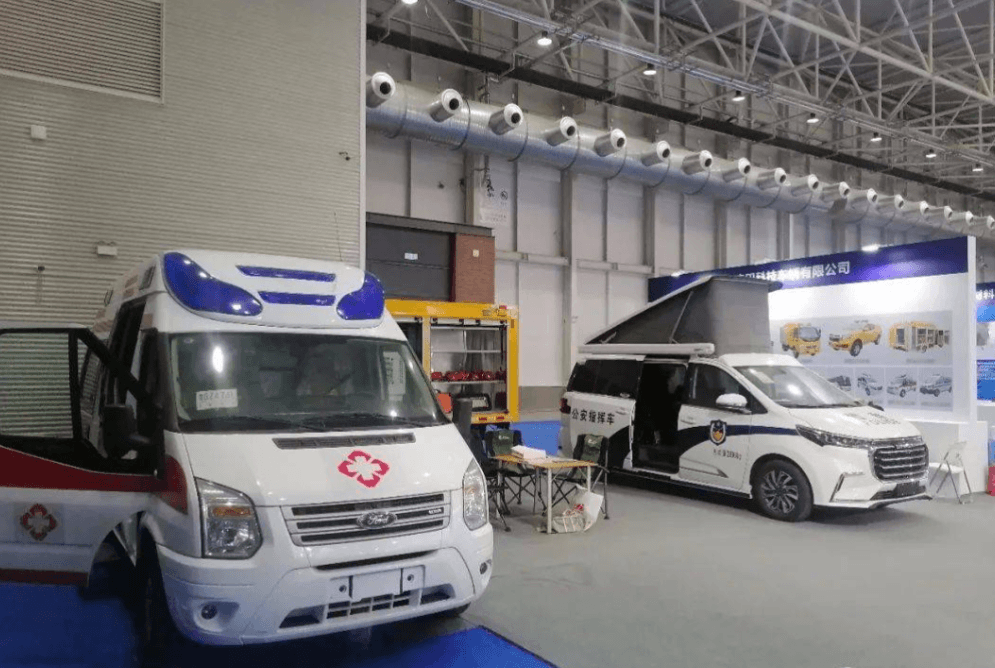
The Nanjing exhibition highlighted that rescue operations are no longer confined to paved roads. The specialized rescue vehicles on display emphasized modularity—the ability to reconfigure a single chassis for diverse disaster scenarios, from earthquake recovery to flood relief.
- All-Terrain Amphibious Units: Designed for regions prone to seasonal flooding, these vehicles utilize low-pressure tires and specialized hull designs to transition seamlessly from road to water.
- Mobile Command & Communication Centers: These are essentially "data centers on wheels." Featuring satellite uplinks, 5G mesh networking, and integrated GIS (Geographic Information Systems), they serve as the central nervous system for multi-agency coordination during large-scale emergencies.
- Hazardous Material (HazMat) Response: Vehicles equipped with negative-pressure cabins and on-board chemical analysis laboratories were a major focus, reflecting the growing safety requirements of the region’s chemical and manufacturing corridors.
| Vehicle Type | Primary Technical Focus | Key Component |
|---|---|---|
| Fire Truck | Suppression & High-Altitude Access | Hydraulic Booms & CAFS Pumps |
| Rescue Vehicle | All-Terrain Mobility & Extraction | Integrated Winches & Modular Chassis |
| Engineering Vehicle | Structural Support & Power Supply | High-Torque PTO (Power Take-Off) |
Engineering Vehicles: Infrastructure and Utility Support
While emergency vehicles capture the headlines, the engineering segment at the Nanjing Special Vehicle Exhibition represents the backbone of urban resilience. These vehicles are engineered for extreme duty cycles and high-precision tasks.
Power Supply and Lighting Trucks
In the aftermath of infrastructure failure, specialized power trucks provide mobile micro-grids. The latest models focus on noise reduction and fuel efficiency, utilizing hybrid power systems to provide 500kW+ of output while maintaining a low thermal and acoustic footprint.
Bridge Inspection and Maintenance Vehicles
These highly specialized units utilize complex articulated arms that can reach under bridge decks while the vehicle remains on the road. The engineering challenge here is balancing the counterweight and ensuring structural rigidity at full extension—a feat of metallurgical and mechanical engineering frequently discussed by OEM project managers at the event.
Vacuum Excavation and Sewer Maintenance
To prevent urban flooding, high-capacity vacuum trucks are evolving. Instead of traditional mechanical digging, these vehicles use pressurized water or air to break up soil, which is then vacuumed into a tank. This "non-destructive" digging is critical for working around buried fiber-optic cables and gas lines in aging urban centers.
Industry 4.0: The Digitization of Special Vehicles
A common thread across all categories at the Nanjing Special Vehicle Exhibition was the "Internet of Vehicles" (IoV). Special vehicles are now mobile IoT nodes.
- Predictive Maintenance: Sensors monitoring hydraulic pressure, engine temperature, and tire wear transmit data to fleet managers, allowing for "just-in-time" servicing before a critical failure occurs during a mission.
- Chassis Electrification: While heavy-duty long-haul trucks still rely on diesel, the exhibition saw a rise in electric and hydrogen-cell light-to-medium duty rescue units. The primary advantage is not just environmental; electric motors provide maximum torque instantly, which is vital for heavy-load startups.
- Ergonomics and Human-Machine Interface (HMI): Modern cabins resemble flight decks, with multi-screen displays and joystick controls replacing traditional levers. This reduces operator fatigue and improves precision during complex maneuvers.
Why the Nanjing Exhibition Matters for Global Procurement
For those in the B2B sector, the Nanjing exhibition serves as a barometer for manufacturing capability. It is a place where "Concept Vehicles" meet "Production-Ready" reality. The concentration of high-tier suppliers in the Jiangsu region means that the vehicles displayed often feature the most recent advancements in steel alloys, hydraulic seals, and electronic control units (ECUs).
From a manufacturing consultant’s perspective, the trend is clear: the market is moving away from generic vehicles toward highly specialized, integrated solutions. The value is no longer just in the chassis, but in the seamless integration of specialized equipment with the vehicle’s digital and mechanical architecture.
Reference Sources
- ISO 16165: Ship and marine technology — Protective coatings and inspection (Applicable to amphibious vehicle standards).
- NFPA 1901: Standard for Automotive Fire Apparatus (The global benchmark for firefighting vehicle safety and performance).
- China Association of Automobile Manufacturers (CAAM): Annual reports on Special Purpose Vehicle (SPV) market trends and manufacturing data.
- GB/T 19001-2016: Quality Management Systems (The Chinese standard equivalent to ISO 9001, critical for SPV manufacturing compliance).