
China has become one of the world’s largest manufacturing centers for special vehicles, vocational vehicles, and customized commercial trucks. From sanitation trucks and fire engines to semi-trailers, truck cranes, mining vehicles, and mobile service vehicles, Chinese manufacturers supply a wide range of specialized transportation solutions to global markets.
However, for international buyers, finding the right supplier is often more complicated than simply searching for a factory.
Why Regionalization Matters
China’s special vehicle industry is highly regionalized. Different cities have developed specialized industrial clusters based on local manufacturing experience, supply chains, engineering capabilities, and supporting industries.
- Suizhou, Hubei: Focus for garbage trucks and municipal service vehicles.
- Liangshan, Shandong: Hub for semi-trailers.
- Xuzhou & Changsha: Centers for truck cranes and concrete pump trucks.
Understanding these manufacturing bases helps overseas importers, distributors, engineering companies, and government contractors choose the right production region, reduce sourcing risks, and improve customization efficiency.

Beyond Low Costs: The Ecosystem Advantage
China’s advantage does not only come from low production costs. The country has developed complete industrial ecosystems that combine:
- Commercial vehicle chassis suppliers
- Body manufacturers
- Component producers
- Hydraulic system companies
- Engineering service providers
How China’s Special Vehicle Manufacturing Industry Works
Unlike passenger cars, most special vehicles follow a two-stage manufacturing process:
- Stage 1: Chassis Production
- Common suppliers: Dongfeng, Foton, FAW, SINOTRUK, and ISUZU China.
- Stage 2: Special Vehicle Body Manufacturing
- Installations include: Garbage compression systems, water tanks, firefighting equipment, cranes, refrigeration units, medical interiors, and hydraulic equipment.
This structure gives Chinese suppliers strong flexibility. A buyer can select a suitable chassis and work with a regional manufacturer to develop a customized vehicle solution.
China Special Vehicle Manufacturing Base Overview
| Manufacturing Base | Province | Main Specialties |
|---|---|---|
| Suizhou | Hubei | Sanitation trucks, fire trucks, rescue vehicles |
| Liangshan | Shandong | Semi‑trailers and transport equipment |
| Shiyan | Hubei | Heavy vocational trucks and special chassis |
| Changsha | Hunan | Construction machinery vehicles |
| Xuzhou | Jiangsu | Truck cranes and lifting equipment |
| Yangzhou | Jiangsu | Refrigerated and medical vehicles |
| Baotou | Inner Mongolia | Mining and heavy‑duty vehicles |
| Zhengzhou | Henan | Mobile service and customized vehicles |
| Chengdu | Sichuan | Emergency and special‑purpose vehicles |
| Liuzhou | Guangxi | Compact urban utility vehicles |
Deep Dive: Major Manufacturing Hubs
Suizhou, Hubei — Municipal & Emergency Vehicles
Suizhou is one of the most important centers in China, featuring a complete industrial chain.
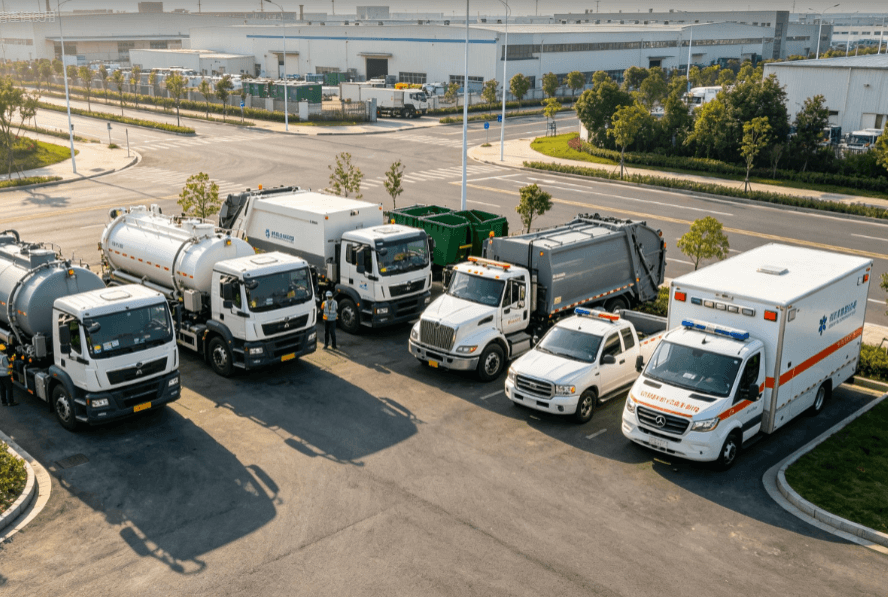
- Strengths: Garbage compactor trucks, road sweepers, water spraying trucks, fire engines, fuel tankers, and rescue vehicles.
- Advantage: Mature modification ecosystem and extensive experience in integrating hydraulic systems and tank structures.
Liangshan, Shandong — Semi-Trailer Manufacturing Hub
One of the largest semi-trailer regions supplying domestic and international logistics markets.
- Strengths: Flatbed trailers, low-bed trailers, dump trailers, container chassis, and heavy transport trailers.
- Advantage: Strong structural engineering and steel fabrication network; flexible OEM production options for dimensions and axle configurations.
Shiyan, Hubei — Heavy Truck & Vocational Chassis
Closely associated with heavy truck history and chassis engineering.
- Strengths: Off-road trucks, mining support vehicles, concrete mixer chassis, and customized 4×4 or 6×6 vehicles.
- Advantage: Expertise in powertrain integration, axle durability, and load-bearing structures for demanding environments.
Changsha, Hunan — Construction Machinery Vehicle Center
A world-class engineering ecosystem for lifting and hydraulic systems.
- Strengths: Concrete pump trucks, truck-mounted cranes, aerial work platforms, and engineering service vehicles.
- Advantage: Advanced intelligent control systems and heavy equipment integration.
Xuzhou, Jiangsu — Truck Crane & Engineering Vehicles
A leading center for lifting technology and heavy machinery.
- Strengths: Mobile cranes, truck cranes, rough terrain cranes, and road maintenance vehicles.
- Advantage: Expertise in telescopic boom technology and load stability systems.
Yangzhou, Jiangsu — Refrigerated & High-End Logistics
Focuses on temperature control, insulation, and customized interiors.
- Strengths: Refrigerated trucks, medical transport vehicles, and insulated vans.
- Advantage: Specialization in sandwich panel structures and thermal insulation materials.
Baotou, Inner Mongolia — Mining & Extreme Environments
Specializes in vehicles designed for harsh industrial conditions.
- Strengths: Mining trucks and heavy-duty off-road vehicles.
- Advantage: Reinforced structures capable of operating in low temperatures and high-dust environments.
Zhengzhou, Henan — Customized Mobile Service Vehicles
Focused on interior integration and specialized equipment installation.
- Strengths: Mobile clinics, command vehicles, mobile offices, and communication vehicles.
- Advantage: Expertise in power supply systems and integrating medical/office facilities into mobile platforms.
Chengdu, Sichuan — Emergency & Advanced Special Vehicles
Leverages a strong background in electronics integration and equipment manufacturing.
- Strengths: Emergency response vehicles and engineering support vehicles.
- Advantage: Suitable for projects requiring complex configurations and high levels of customization.
Liuzhou, Guangxi — Compact Urban Utility Vehicles
Known for small commercial vehicles and economical urban solutions.
- Strengths: Small sanitation trucks, urban service vehicles, and delivery vehicles.
- Advantage: Ideal for narrow roads and dense populations where efficient municipal services are needed.
[top special vehicle manufacturing bases in China-2]
Guide for International Buyers: How to Choose
Start with the Vehicle Application
Identify the exact operating purpose. Choosing the right industrial cluster (e.g., Suizhou for sanitation, Liangshan for trailers) reduces communication costs and improves quality.
Confirm Chassis Requirements
The chassis determines payload, durability, and maintenance. Confirm:
- Brand (Dongfeng, Foton, FAW, SINOTRUK, ISUZU)
- Engine specs & Emission standards
- Driving side (LHD/RHD) & local road regulations
Evaluate OEM Customization Capability
A reliable supplier should handle modifications for:
- Local climate and road conditions
- Specific government regulations
- User-specific functional requirements
Check Export Experience and Compliance
Verify export documentation capability, quality management systems, and experience with destination-country regulations and logistics.
The OEM Manufacturing Process
- Requirement Confirmation: Buyer provides application, environment, and technical specs.
- Chassis Selection: Manufacturer recommends a suitable platform.
- Engineering Design: Development of body structure, hydraulics, and electrical layouts.
- Production & Testing: Fabrication, assembly, quality inspection, and export prep.
Why Source Special Vehicles from China?
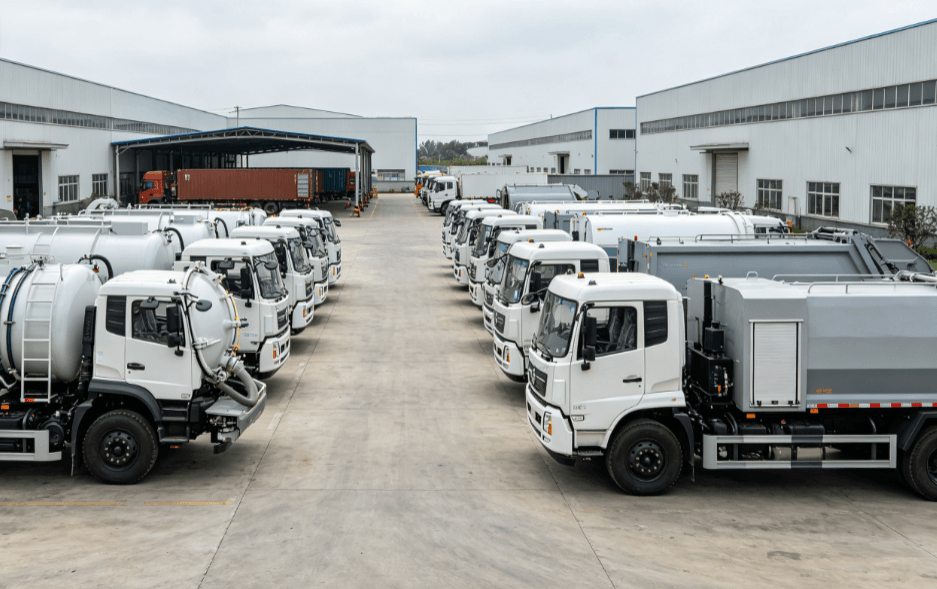
- Supply Chain Integration: Chassis, components, and engineering are often in the same region.
- Manufacturing Flexibility: Ability to produce both standard models and highly customized solutions.
- Cost Efficiency: Mature ecosystems reduce component costs and shorten production cycles.
Conclusion: Choosing the Right Ecosystem
China’s special vehicle industry is built around specialized regional clusters. For global buyers, success is about selecting the manufacturing ecosystem that matches your technical requirements and long-term business goals. Identifying the right production region is the first step toward building a reliable global supply chain.