
Procuring a medical vehicle is a high-stakes decision where automotive reliability meets clinical precision. For international procurement officers, the ambulance price quoted by Chinese manufacturers often varies wildly, leading to confusion. Is a $30,000 unit comparable to a $70,000 one? The answer lies in the engineering hidden beneath the paint.
Understanding the Chinese ambulance market requires a shift in perspective. You are not just buying a van; you are investing in a mobile life-support environment. The following analysis breaks down the technical drivers of cost and the critical classifications used in modern emergency medical services (EMS).
China Ambulance Price Range: Export Cost Overview (2026)
One of the first questions international buyers ask is: How much does an ambulance cost from China? The answer depends on the vehicle chassis, medical conversion level, onboard equipment, and export requirements.
As a general reference, Chinese ambulance export prices typically fall into the following ranges:
| Ambulance Type | Typical Export Price Range | Main Application |
|---|---|---|
| Patient Transport Ambulance (Type A) | USD 25,000–40,000 | Non‑emergency patient transfer, clinics, rural healthcare |
| Emergency Ambulance (Type B) | USD 40,000–65,000 | Emergency response, trauma transport, EMS fleets |
| ICU Ambulance (Type C) | USD 60,000–120,000+ | Advanced life support, critical patient transfer |
| Negative Pressure Ambulance | USD 80,000–150,000+ | Infectious disease control and isolation transport |
- Base chassis brand and engine configuration
- Left-hand drive or right-hand drive requirements
- Medical equipment package
- Oxygen and electrical system specifications
- Local certification requirements
- Shipping destination and export regulations
A low-cost ambulance may meet basic transportation needs, while a premium ICU ambulance is closer to a mobile intensive care unit with advanced electrical, oxygen, and monitoring capabilities.
.png "ambulance price-1")
Critical Factors Influencing Ambulance Price
The ambulance price is primarily dictated by three pillars: the chassis, the medical interior construction, and the integrated life-support technology.
The Chassis Foundation
The vehicle platform represents 40% to 60% of the total cost. In China, buyers typically choose between three tiers:
- Tier 1 (Global Standard): Ford Transit (V348/V362) and Mercedes-Benz Sprinter. These offer the highest resale value and global parts availability.
- Tier 2 (Industrial Workhorses): Iveco Daily and Maxus (SAIC). These provide excellent interior height and volume for ICU conversions.
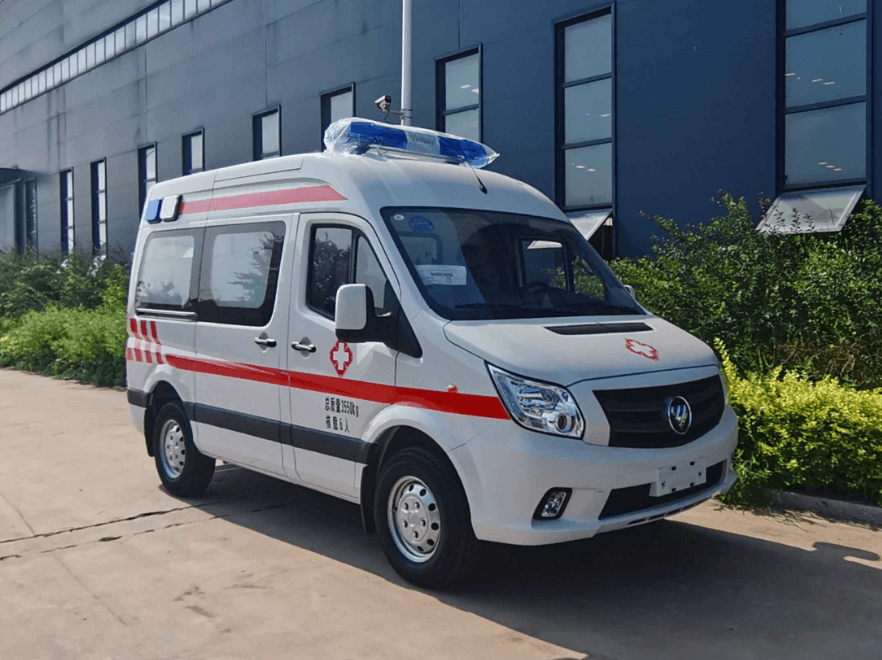
- Tier 3 (Budget-Friendly): Foton and Jinbei. Ideal for short-distance patient transport or large-scale rural health initiatives where the budget is constrained.
Medical Cabin Material Science
Cheap conversions use hand-pasted fiberglass or basic PVC boards. These are prone to cracking, difficult to disinfect, and can release harmful VOCs. High-end manufacturers utilize:
- Vacuum-Formed ABS: Lightweight, seamless, and easy to clean.
- Integrated FRP (Fiberglass Reinforced Plastic): High impact resistance and fire-retardant properties.
- Aluminum Alloy Cabinetry: Preferred for military-grade or heavy-duty off-road ambulances due to its structural integrity.
Electrical and Oxygen Infrastructure
A failure in the oxygen delivery system or a power surge in the inverter can be fatal. Premium pricing often includes redundant electrical systems, pure sine wave inverters (essential for sensitive medical electronics like ventilators), and copper-piped oxygen systems with central manifolds.
Technical Classification: Understanding Ambulance Types
Choosing the right vehicle starts with matching the clinical need to the vehicle's technical capabilities. According to international standards like EN 1789, ambulances are categorized based on their intended use.
For a deeper dive into how these vehicles are structurally modified for different medical missions, you can explore the technical breakdown of ambulance types used in modern healthcare fleets.
Type A: Patient Transport
Designed for non-emergency transport. These vehicles focus on comfort and basic stabilization. They are typically smaller, more fuel-efficient, and have a lower ambulance price compared to emergency units.
Type B: Emergency Ambulance
The "workhorse" of the EMS fleet. These are equipped for the treatment and monitoring of patients. They require sophisticated storage for drugs, trauma kits, and basic airway management tools.
Type C: Mobile ICU (Intensive Care Unit)
These are high-spec vehicles designed for advanced life support (ALS). They feature reinforced flooring for heavy equipment and advanced electrical outputs to support multi-parameter monitors, defibrillators, and infusion pumps simultaneously.

Manufacturing Excellence: How to Evaluate a Chinese Manufacturer
When sourcing from China, the goal is to find an OEM partner that understands international medical standards. A reliable manufacturer doesn't just "install cabinets"; they engineer a medical space.
Key Technical Checklist:
- Weight Distribution: A poorly balanced ambulance affects braking and cornering. Ask for the center of gravity calculation for a fully loaded unit.
- EMI/EMC Compliance: Ensure the vehicle's electrical systems do not interfere with medical monitoring equipment.
- Certification: Look for ISO 9001 and ISO 13485 (Medical Device Quality Management).
If you are currently evaluating models for a specific project, reviewing a specialized ambulance range can provide a baseline for the chassis-to-equipment configurations currently available for export.
- Specialized Ambulance Types for ICU Neonatal and Emergency Medical Transport
- Emergency vs Non-Emergency Ambulance: Complete Guide for Global Buyers
- Type I vs Type II vs Type III Ambulance: Global Buyer Guide from China
- What Is the Difference Between BLS and ALS Ambulances?
- Top 10 Ambulance Vehicle Manufacturers in China: 2026 Ranking & Buyer’s Guide
The Specialized Case: Negative Pressure Ambulances
The global demand for infectious disease control has made the Negative Pressure Ambulance a standard requirement. The ambulance price for these units includes a specialized filtration system that costs significantly more than standard HVAC.
Technical Specifications to Demand:
- Pressure Gradient: The system must maintain a negative pressure of -10 Pa to -30 Pa.
- Air Change Rate: The cabin air should be exchanged at least 20 times per hour.
- Filtration: HEPA (High-Efficiency Particulate Air) filters must reach 99.97% efficiency for 0.3μm particles.
Procurement Strategy: Total Cost of Ownership (TCO)
Experienced buyers know that the initial ambulance price is only part of the equation. To ensure long-term value, consider:
- Spare Parts Availability: Does the manufacturer provide a "wear-and-tear" kit? This should include fuses, oxygen terminals, and cabinet latches.
- Warranty Logistics: How does the manufacturer handle warranty claims internationally? Look for partners who offer video technical support and rapid courier of replacement components.
- Climate Customization: If the vehicle is for the Middle East or Africa, specify an independent, high-capacity rooftop AC unit. Standard vehicle AC will fail to cool the medical cabin under 40°C+ conditions.
Conclusion
Navigating the Chinese ambulance market requires a balance of technical scrutiny and commercial pragmatism. While the ambulance price is an important metric, the safety of the patient and the medical crew depends on the quality of the conversion. By focusing on chassis reliability, material durability, and clinical compliance, procurement managers can secure high-performance vehicles that offer a superior return on investment.
Reference Sources
- CEN EN 1789:2020: Medical vehicles and their equipment - Road ambulances.
- SAE J3043: Ambulance Equipment Mount Process and Devices. This standard governs the safety of equipment mounting in the event of a crash.
- WHO (World Health Organization): Technical specifications for specialized medical vehicles.